
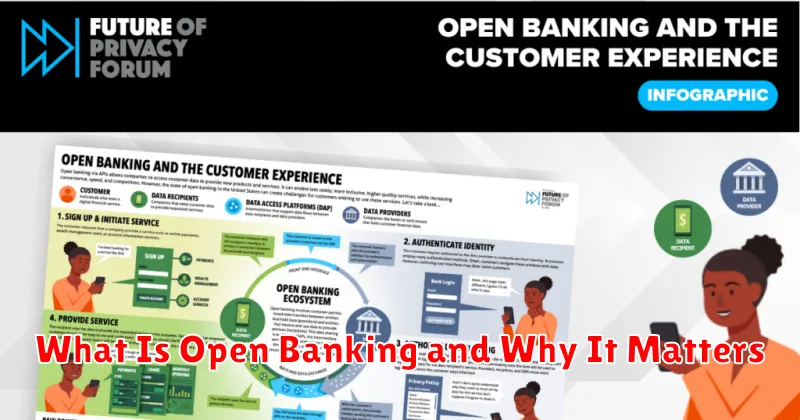
In today’s rapidly evolving financial landscape, Open Banking is transforming the way we interact with our financial data. Open Banking empowers consumers and businesses by enabling third-party providers access to financial information through secure APIs (Application Programming Interfaces). This innovative approach fosters competition, promotes transparency, and unlocks a wealth of opportunities for personalized financial management. This article will explore the core concepts of Open Banking, examining its underlying mechanisms and delving into its significance for consumers, businesses, and the broader financial ecosystem.
Understanding the implications of Open Banking is crucial for navigating the modern financial world. From streamlined account aggregation and personalized financial advice to innovative payment solutions and enhanced fraud detection, the benefits of Open Banking are numerous. We will examine why Open Banking matters, highlighting its potential to revolutionize financial services and empower individuals and businesses alike. Explore the transformative power of Open Banking and discover how it is reshaping the future of finance.
The Concept of Open Banking
Open banking centers around the secure sharing of consumer financial data. This data, which traditionally resides within banks, can be accessed by authorized third-party providers (TPPs) through application programming interfaces (APIs). Consent is paramount; consumers must explicitly permit data sharing.
This controlled access empowers consumers with greater control over their financial information and fosters innovation within the financial services industry. TPPs can use this data to develop personalized financial products and services, from budgeting apps to sophisticated investment tools.
How It Works with APIs
Open Banking relies heavily on application programming interfaces (APIs). These APIs are sets of rules and specifications that allow different software systems to communicate with each other securely and efficiently.
In the context of Open Banking, APIs enable third-party providers (TPPs) to access customer financial data held by banks. This access is granted with the customer’s explicit consent. The APIs standardize the data exchange process, ensuring that information is transmitted in a consistent and secure manner.
Through these APIs, TPPs can build innovative financial products and services, such as personalized budgeting apps, account aggregation tools, and more efficient payment solutions.
Benefits for Consumers and Businesses
Open banking offers numerous advantages for both consumers and businesses. For consumers, it fosters increased competition among financial providers, potentially leading to better interest rates and lower fees. It also empowers consumers with greater control over their financial data, enabling them to make more informed decisions.
Businesses benefit from open banking through streamlined processes, such as faster and more efficient loan applications. It also opens up opportunities for innovation, allowing businesses to develop new financial products and services tailored to specific customer needs.
Security and Privacy in Open Banking
Security and privacy are paramount in open banking. Strong encryption and secure APIs are fundamental to protecting sensitive financial data. Open banking regulations often mandate multi-factor authentication and explicit consent from users before data sharing occurs.
Consumers must understand the permissions they grant to third-party providers (TPPs). TPPs are subject to strict regulatory oversight to ensure they handle data responsibly and securely. While open banking offers significant benefits, users should remain vigilant about their data and choose reputable providers.
Banks and Third-Party Integrations
Open banking facilitates seamless integrations between traditional banks and authorized third-party providers (TPPs). Through secure and standardized application programming interfaces (APIs), TPPs can access customer-permissioned financial data and services.
This interconnectivity empowers TPPs to develop innovative financial products and services. Examples include personalized financial management tools, automated budgeting apps, and streamlined lending platforms. Data sharing lies at the core of open banking, requiring banks to provide secure access while adhering to strict regulatory guidelines regarding customer privacy and security. Collaboration between banks and TPPs fuels the advancement of the financial landscape, fostering greater competition and offering consumers more tailored solutions.
New Opportunities for Innovation
Open banking fosters a dynamic environment ripe with possibilities for innovation. Application Programming Interfaces (APIs) enable third-party developers to build new financial products and services, leading to increased competition and customized solutions for consumers.
This access to financial data empowers developers to create personalized financial management tools, innovative payment solutions, and sophisticated risk assessment models. Businesses can leverage this data to offer targeted products and services, improving customer experiences and driving growth.
Challenges and Criticisms
While open banking offers significant potential, it also faces various challenges and criticisms. Security concerns are paramount. Data breaches and unauthorized access to sensitive financial information are major risks.
Data privacy is another key concern. Consumers worry about how their financial data is being used and shared. Standardization and interoperability issues can hinder seamless data exchange between institutions.
Liability in cases of fraud or errors presents a complex challenge. Determining responsibility when multiple parties are involved requires careful consideration. Finally, the dominance of large technology companies in the open banking ecosystem raises concerns about competition and potential monopolies.
Global Adoption Status
Open banking adoption varies significantly across the globe. Some regions have established mature open banking ecosystems, while others are in nascent stages of development or exploration. Regulatory frameworks play a crucial role in driving adoption, with some governments actively promoting open banking through legislation and industry initiatives.
The European Union, with its revised Payment Services Directive (PSD2), has been a pioneer in open banking. The United Kingdom has also seen significant progress. Other countries, including Australia, Canada, and several in Asia and Latin America, are increasingly embracing open banking principles and implementing supportive regulations.
Examples of Open Banking Apps
Open Banking has fostered innovation in financial services, resulting in various helpful apps. Here are some examples:
Budgeting and Personal Finance Management
These apps aggregate financial data from multiple accounts across different institutions, providing users with a holistic view of their finances. They often include features for budgeting, spending analysis, and financial goal setting.
Account Aggregation and Comparison
Some apps focus on providing a consolidated view of all accounts, simplifying balance checking and transaction tracking. Others go further by allowing users to compare financial products like loans and mortgages from different providers.
Automated Financial Advice and Savings
Robo-advisors leverage open banking to analyze user spending habits and provide personalized financial advice. Automated savings apps can analyze spending patterns and automatically transfer surplus funds into savings accounts.
Future Trends to Watch
Open banking is constantly evolving. Several key trends are shaping its future. Increased personalization will likely be a major focus, with financial institutions leveraging open banking data to offer highly customized products and services.
Expansion beyond traditional banking is also anticipated. We can expect to see open banking principles applied to sectors like insurance and wealth management, creating a more interconnected financial ecosystem.
Enhanced security measures will be crucial for maintaining consumer trust. As data sharing expands, robust security protocols and advanced fraud detection mechanisms will become increasingly important.
