
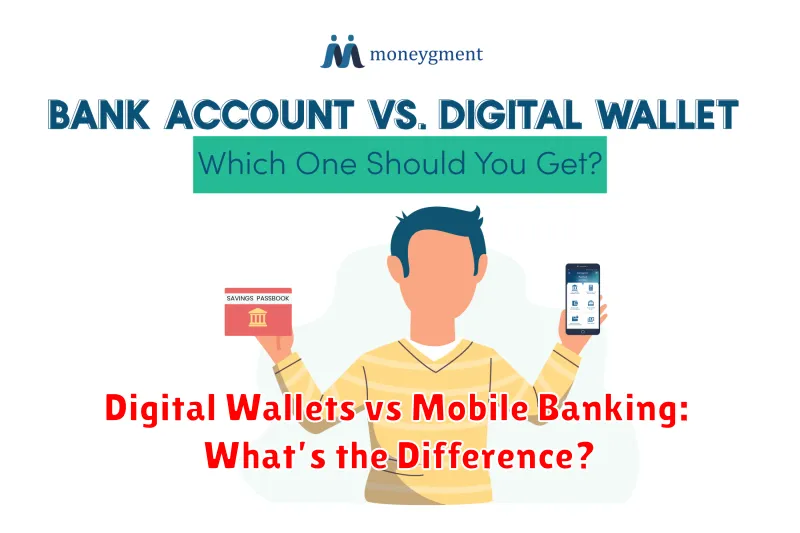
In today’s fast-paced digital world, managing finances has become increasingly convenient thanks to advancements in technology. Two popular methods for managing money on the go are digital wallets and mobile banking. While they might seem similar at first glance, there are key differences between the two. Understanding these distinctions is crucial for making informed decisions about how you manage your finances electronically. This article will delve into the nuances of digital wallets vs mobile banking, exploring their functionalities, benefits, and drawbacks to help you choose the best option for your needs. We’ll cover what digital wallets and mobile banking are, how they work, and the key differences that set them apart.
Are you confused about whether to use a digital wallet like Apple Pay or Google Pay, or stick with your bank’s mobile banking app? You’re not alone. Many people struggle to understand the differences between these two powerful financial tools. This comprehensive guide will clarify the distinction between digital wallets and mobile banking, highlighting their respective strengths and weaknesses. Learn how each method works, discover the benefits they offer, and understand the security implications involved in using digital wallets and mobile banking. By the end of this article, you’ll be equipped with the knowledge to choose the best solution for your digital finance needs.
Defining Digital Wallets and Mobile Banking
Understanding the distinction between digital wallets and mobile banking requires clear definitions of each. Digital wallets are essentially electronic devices, online services, or software programs that allow individuals to make electronic transactions. This encompasses a wide range of payment methods, from contactless in-store purchases to online shopping.
Mobile banking, on the other hand, refers specifically to using a mobile app to access and manage traditional banking services. These services typically include checking account balances, transferring funds between accounts, paying bills, and sometimes even depositing checks remotely. While there can be overlap in functionality, the core purpose of each remains distinct.
How They Operate and Integrate
Digital wallets and mobile banking apps, while offering overlapping functionalities, operate and integrate differently with your finances. Mobile banking apps are extensions of your traditional bank account. They provide a digital interface to manage your existing accounts, view transactions, transfer funds, and pay bills. They are directly tied to your bank and operate within its established infrastructure.
Digital wallets, on the other hand, act as intermediaries. They store payment information from various sources, including bank accounts, credit cards, and debit cards. This information is then used to facilitate transactions without directly accessing your bank account each time. Digital wallets integrate with various merchants and online platforms, offering a streamlined checkout experience.
Security Features Compared
Both digital wallets and mobile banking apps incorporate robust security measures, although they differ in their implementation. Mobile banking relies heavily on multi-factor authentication, such as passwords and one-time PINs sent via SMS or email. It also benefits from the existing security infrastructure of banks, including fraud detection and monitoring.
Digital wallets often utilize tokenization, replacing sensitive card details with unique tokens for each transaction. Biometric authentication, like fingerprint and facial recognition, is also commonly used. While digital wallets do not rely on bank security systems in the same way, they offer strong transaction-specific protection.
Spending and Saving Capabilities
A key differentiator between digital wallets and mobile banking lies in their spending and saving functionalities. Mobile banking primarily focuses on managing accounts held at a specific financial institution. This includes checking balances, transferring funds between accounts, and paying bills. While some banks offer integrated peer-to-peer (P2P) payment options, the core function remains account management.
Digital wallets, conversely, offer a broader range of spending options. They facilitate contactless payments in stores, online purchases, and P2P transfers often irrespective of the user’s primary bank. While some digital wallets allow for limited savings features like cashback rewards or round-up programs, they are not designed for comprehensive savings management like a traditional bank account or dedicated savings app.
When to Use Each Option
Deciding between mobile banking and digital wallets depends on the situation. Use mobile banking for managing your finances holistically. This includes checking balances, transferring funds between accounts, paying bills, and depositing checks. Think of it as your virtual branch.
Digital wallets excel for contactless payments in physical stores and online. They streamline the checkout process and enhance security by tokenizing your card information. Use them when convenience and speed are paramount.
Limits and Regulations
Both digital wallets and mobile banking apps operate under various limits and regulations. Transaction limits often apply to both, although they can vary depending on the provider and the user’s verification status. These limits might be daily, weekly, or monthly. Balance limits may also be imposed on digital wallets, restricting the amount of money that can be stored at any given time.
Regulations surrounding both services are primarily focused on security and preventing fraud. Know Your Customer (KYC) and Anti-Money Laundering (AML) regulations are common in many jurisdictions. These regulations require financial institutions and digital wallet providers to verify the identities of their users and monitor transactions for suspicious activity.
Global Usage Trends
Digital wallets are experiencing significant growth globally. Increased smartphone penetration and the convenience they offer contribute to this rise. Markets in Asia, particularly China, have seen widespread adoption, often leapfrogging traditional card-based payments.
Mobile banking, while also growing, shows varying adoption rates depending on the region. Developed nations with established banking infrastructure generally exhibit slower mobile banking growth compared to regions with developing economies where mobile banking often serves as a primary financial access point.
Both technologies face challenges in terms of security concerns and regulatory hurdles, influencing their adoption rates across different markets.
Are Banks Losing Ground?
The rise of digital wallets has undoubtedly shifted the financial landscape. While banks still hold a significant role, digital wallets offer a compelling alternative for everyday transactions. This begs the question: are traditional banking institutions losing ground to these new fintech players?
The answer is nuanced. Digital wallets excel in convenience and speed for point-of-sale purchases and peer-to-peer transfers. However, banks continue to dominate in areas like lending, investment services, and overall financial management.
Rather than a complete takeover, we’re seeing a shift in consumer behavior. Many individuals utilize both digital wallets and traditional banking services, leveraging the strengths of each.
Hybrid Models Emerging
The lines between digital wallets and mobile banking are increasingly blurred. Hybrid models are emerging that combine the strengths of both. These offerings often integrate core banking services, like account balance checks and transfers, within a digital wallet interface. This provides users with the convenience of a digital wallet for everyday transactions, while also offering access to traditional banking functionalities.
These integrated solutions aim to provide a seamless and comprehensive financial experience. Users can manage their finances, make payments, and track spending all within a single application. This convergence is expected to continue as consumer demand for integrated financial solutions grows.
What Users Prefer Today
Determining a clear “winner” between digital wallets and mobile banking is challenging because they often serve different, yet overlapping, purposes. Many users leverage both technologies.
Current trends suggest a rise in digital wallet adoption for point-of-sale transactions, driven by convenience and increasing contactless payment options. Mobile banking remains crucial for account management, balance checks, and transfers.
Ultimately, user preference depends on individual needs and circumstances. Factors like access to specific technologies, merchant acceptance, and personal comfort levels with security protocols all contribute to the choice.
